|
|
|
|
|
By Cynthia LeRouge, CPA This new way of operating lets you
tailor products and services for individual customers. And there are numerous tools
available to help you. “WTo be competitive, companies need to offer products and services made to order for each of their customers. Professional services firms—such as business consulting, architect construction, and engineering—have always provided customized solutions. But now information technology makes it possible for most industries to offer tailored solutions on a broad scale. “Internal” customers also want individual solutions, especially when organizational teams are seeking to satisfy sophisticated intercompany needs. For example, many companies require dedicated solutions from internal information technology teams in addressing such issues as accounting requirements, Euro-currency issues, or multimedia staff training programs. What makes a solution customized? Just about anything, including a unique collection of human resources organized as a project team, a bundle of different services that can range from development to installation to training, or the willingness to provide the service or good according to a customer-specified timetable. Often the best strategy for providing such customized solutions is a project approach. Unlike traditional manufacturing processes or retained time services, projects are temporary and have defined budgets and time schedules. In fact, the Project Management Institute defines a project as: A temporary endeavor undertaken to create a unique product or service. “Many professional firms simply do not view themselves as project based—so the entire concept of management by projects catches them off guard. However, once we are able to show them how a project system works, it quickly becomes clear that they actually are project-centric and this kind of approach to managing their business can help ensure they continue to operate very profitably,” Matt Fogo, managing director of sales for the Midwest Region, Deltek Systems, Inc., says. TAKING A STRATEGIC APPROACH This isn’t the same as project management. Managing by projects means financial professionals and other executives use a global perspective to strategize and analyze operations by looking at project information. This perspective arms them with the knowledge to make real-time adjustments to strategy when key indicators show a shift is necessary.
Artemis Management Systems offers a useful comparison shown in the sidebar above. I’m sure that, as astute financial professionals, you’re aware of the benefits your organization can derive from employing good management-by-projects techniques. Maximizing profitability often means looking beyond the categorization of costs and revenues provided by a financial statement and into the effectiveness and net profit associated with each project. Ultimately, profitability rests on the successful management and control of your company’s collection of projects. Your company especially can benefit when senior executives understand the strategic uses of management by projects. Here are some examples I compiled from interviews with industry executives who employ a management-by-projects philosophy in their organizations: Strategic Marketing. With good project financial information, marketing executives can look across all projects to identify profitable types of clients/projects and aggressively target those for future business. Conversely, they can identify losers and avoid them. Profit Planning. With accurate project data for past years, financial executives can build more accurate forecasts and budgets for future years. It’s a constructive approach where each project is a building block used to assemble the corporate financial vision. This aggregated projects approach provides insight, accuracy, and sometimes a level of accountability that can’t usually be achieved with more traditional top-down general ledger accounting or departmental budgeting. Empowerment of Project Managers. Project managers who can access timely, complete project information can manage a greater number of projects with greater success. Greater efficiency leads to leveraged resources as well as higher-quality customer work. Strategic Resource Allocation. In many technologically advanced industries, the availability of skilled labor has become a critical constraint because resources are scarce and geographically dispersed. With detailed employee and project information, resources (both human and material) can be allocated more efficiently across projects. The skills required for managing by projects across an enterprise can be complex as can the information you’ll glean. When you’re managing by projects, you accumulate and summarize information about individual projects. On the basis of this aggregated data, you can analyze projects from various angles to determine criteria for success. Now there are many project software tools available that let you do such things as “roll up” individual project information by parameters such as the project manager assigned, the time frame, or the customer. Frequently, drill-down capabilities are also available from inquiries or online reports. Good managers in project-centric organizations track key project indicators carefully so they can make real-time adjustments as needed. And this means having the right tools and the right knowledge. If you aren’t that familiar with project management, take a look at the list of terms and definitions. PROJECT PHASES
Initiation. Before anyone initiates a project, management should set general vision or mission statements to identify the types of projects most desirable for the company in terms of objective, duration, and budget. This is often called the “target market,” and the statements can include general budget or cost-benefit (internal project) guidelines. A management-by-projects approach provides executives with information about past and current projects that they can use to evaluate risk and profit (or cost/benefit for internal projects) potential for major undertakings. Planning Phase. Executive plans or philosophies usually dictate the selection of project managers or service managers who’ll have the direct authority to run projects. Existing staff members with other responsibilities may fill this role, or professional project managers may be needed. Project management has become a fast-growing, recognized profession with its own standards and certifications. The ideal project manager would have finance and accounting knowledge, operational planning skills, organizational structure knowledge, communication skills, time management, problem-solving, negotiating, and even stress management skills. Management may identify guidelines associated with “deliverables” for this phase and even provide work breakdown structure templates that reflect the successful organization of activities of similar previous projects or amended strategies. The work breakdown templates direct the project manager in assigning costs, labor resources, projected revenues, material resources, time duration, and other project components. Complexity and duration usually determine the level of detail required. This is a crucial—and one of the most difficult—parts of a project. The planning efforts around the work breakdown structure may result in estimates, bids, PERT and Gantt charts, detailed project budgets, resource schedules, and other such directional reports. Executives can aggregate the planning information to determine where time conflicts, resource conflicts, or resource shortage issues may exist so changes can be made with no compromise to revenue or increase in costs. Execution and Controlling Phases. Project managers (at a detail level) and executives (at a global level) review resource utilization, estimates to complete, variance analysis costs curve analysis, and time and expense reports. Networked and Web-enabled project systems facilitate prompt, accurate time and expense reporting, and they communicate status and project issues to management when face-to-face meetings aren’t possible or cost effective. Often, key alert rules and routing may be automated with project software applications to expedite management action in critical situations. Closing Phase. This phase is a final determination of quality and means that no additional work is required to meet customer or internal needs. The goal of this phase is to achieve formal consensus that the project has been completed. Though this may seem rudimentary, executives may require this formality to ensure that profits or cost control of projects aren’t chipped away when people disagree regarding project completion. As a last piece, executives may, by policy, request that project managers ensure that all project information, including team member skills and experience, is updated in appropriate databases for future planning purposes. THE TOOLS
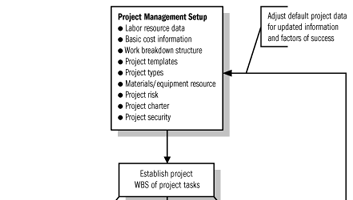
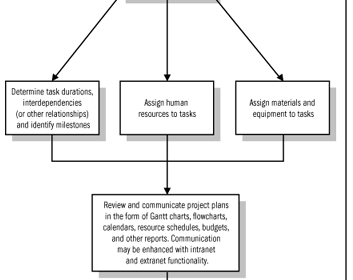
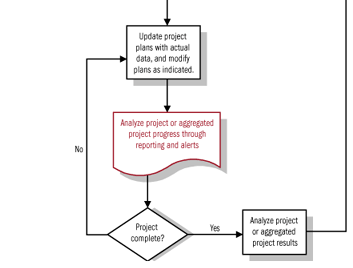
During the project planning phase, you can use software to establish the work breakdown structure, create timelines, assign resources, budget costs, prepare estimates, and perform what-if analysis. During the execution and controlling phases, you can use software to accumulate actual costs and revenues, monitor progress to plans, generate charts and reports such as estimates-to-complete, and adjust plans based on analysis. Project software also lets management quickly hone in on problems and make appropriate adjustments immediately. Dennis Stejskal, Timberline VP and director of accounting, explains: “With a click of the mouse, the executive can get a high-level overview of the entire project—the revised contract amount, cost to complete, project profit, and percent complete. With the next click, they can ‘drill down’ to the next level of detail on the job, seeing total estimates, job-to-date costs, and remaining estimate figures for cost codes and so forth until the problem is isolated and a solution identified to set the project back on a success track.” During the closing phase, project accounting software contributes information to fulfill contractual or other guidelines of obligations. It also provides a way to review historic project information for remuneration review or planning for future projects. PROJECT MANAGEMENT SOFTWARE Project management software contains applications that help managers plan and control project time schedules, processes (steps), and labor resources. Project management reporting is often in the form of charts, graphs, and tables (such as PERT charts, Gantt charts, and calendars). Figure 1 shows a process flow for project management.
A casual user would be comfortable with a solid desktop-level project management package. Professional-level systems are designed to be more of an enterprise information system and have more robust functionality than most desktop-level systems. Professional-level project management applications support multiple users of project files while maintaining security restrictions. One of the most robust features that professional-level systems offer is multiproject analysis for interrelated projects, which refers to the software’s ability to support hundreds of resource schedules and activity calendars simultaneously as well as the ability to combine and separate projects, as desired, for reporting purposes. The gap between professional-level and desktop software is bridged by project management applications that can vary the level of functional requirements per user and still let everyone use the same database. That means a desktop user or a user requiring only summary information wouldn’t be burdened with the functionality and details required by a power user within the same organization. Artemis Management Systems achieves this multilevel system with a concept called “Briefing Books.” Briefing Books organizes project metrics into interactive charts, graphs, and reports so executives can track project and individual performance and isolate areas for improvement while project managers can maintain a more detailed, individual project perspective. The same effect can be achieved when a desktop application is equipped with features that let it integrate with more complex professional-level packages. Because resources are a key cost in many project-centric organizations, you may want to look to project scheduling applications as a tool to facilitate labor cost and effectiveness. Most packages provide features that let users review project manager or department manager on-time and on-budget performance, and many also offer features aimed at human resource planning. Patrick Durbin, president and CEO of PlanView Inc., says, “A project or resource manager can sort and filter information, not just by projects or programs but by resource groups or individual staff member or contractor, to get a resource-centric view of work. PlanView Software also allows organizations to search a central repository of work and resource data to find the best persons for a task by skills and other criteria. It ranks the resources by availability using a ‘best fit’ algorithm. Skills tracking is critical for effective resource management, especially in the technology arena where skills can become critical—or stale—in just a few months.” PROJECT ACCOUNTING SOFTWARE Modern project accounting software is tightly integrated with a company’s financial accounting system. In fact, the degree of integration is often an important feature you should look for in selecting a project accounting tool. Companies avoid double entry of cost and revenue data though integration with accounts payable, accounts receivable, payroll, inventory, and purchasing modules. What’s the need for project software if there’s already a financial accounting system in place? According to Alan Heller, director of business development with Design Data Systems, “Traditional MRP and ERP solutions do not provide an adequate means for planning and analyzing the utilization and expenses of the key resources of service providers—people. Traditional MRP and ERP solutions did not track the service business process unless a method for tracking the project (bundle of goods and services making up the system) was at its core. As the service component of the technology sale increases, so does the time it takes to fulfill the requirements of the sale. If it is going to take more than a few days to fulfill the sales commitment, you have a project that requires a project accounting tool to track the associated process, costs and revenues.” The capabilities of project accounting packages go far beyond “transactions by project.” Project accounting seeks to centralize all project transactions for the purposes of control, accuracy, and efficiency. Inputting and maintaining setup and default information, such as cost and billing rates and revenue recognition methods, is part of most project accounting packages allowing users to save processing time and avoid errors. Software creators recognize that each project is unique and strive to provide the flexibility that lets you account for the nuances of each individual project while still providing extensive aggregation features. Project accounting software also may automate some management duties. “The system can facilitate the implementation of workflow logic, forcing responsibility checks and online approvals for discreet processes. As an example, a priority project with a sensitive client may require high-level executive review before an invoice is generated. Workflow logic would automatically alert the executive of the existence of a draft invoice and allow online review and manipulation of it before it was released to the client,” Steve Dennis, VP and general manager of Solomon Software Project Management Group, says. The “time is money” cliché is a reality in a project-centric service industry. Project accounting software can expedite the billing process as well as provide invoice flexibility. “Because time is entered in an ongoing manner, it minimizes the gap between work-performed and work-invoiced. The quicker invoices are released, the quicker funds are collected,” notes Robert Nehme, VP of marketing for TECSYS. Project accounting software comes in several forms:
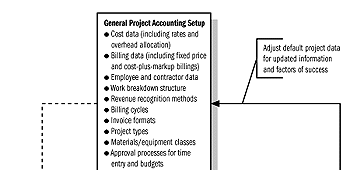
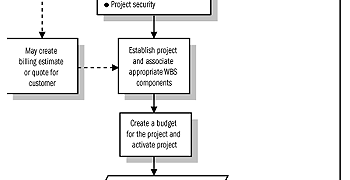
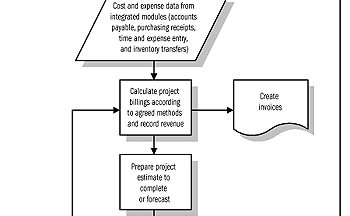
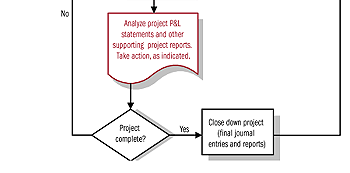
As financial professionals, you should seek applications that integrate with financial systems and project management software. Integrated systems typically share information with payroll, inventory, accounts payable, accounts receivable, sales order, and project management software. Through integration, companies can achieve maximum data efficiency and system effectiveness. Integrated project accounting systems access data from the various components to produce more meaningful reports and queries for users needing extensive details or summary information. Figure 2 provides a typical project accounting flow.
CHOOSING THE TOOLS
In addition, determine your project software requirements based on the general direction of business deals and internal activities in terms of billing, resource utilization and cost methods, budgeting procedures, and contract or specification provisions. An enterprise system that integrates both project management and project accounting software with existing financial applications is quite powerful. But make sure you examine whether you need one or both of these applications. For example, if you have minimal resource management needs, you may find a project accounting solution alone suits your purposes. Likewise, don’t disregard project software because it was designed for a particular industry. Construction and engineering firms have been long-term extensive users of project accounting and job cost systems to the point of established standards. So, naturally, some project accounting vendors, particularly those offering more mature and specialized packages, have developed around the needs of these historic target markets. Your company’s specific needs should drive the desired software functionality. PART OF THE SOLUTION Cynthia LeRouge, CPA and certified technical trainer, is a consultant and Ph.D. candidate at the University of South Florida. She has been an auditor and tax specialist for two of the Big 5 professional services firms, a controller, an ERP systems consultant, and an applications training manager for an ERP systems developer and a comprehensive project-based systems developer. You can contact her at lerouge@tampabay.rr.com or (727) 867-5336. | |||||||||||||||||||||||||||||||||||||||||||||||||||||||||||||||
|